February 7, 2042
Glen Ellyn
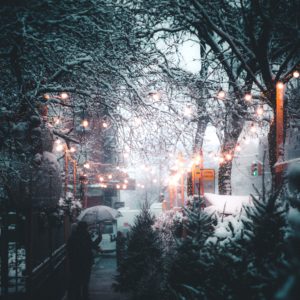
It’s a Friday afternoon, that last day. There’s over a foot of week-old snow on the ground. The last several days have been bright and sunny — too cold for snow — but today the sky is gray and heavy. Naomi and I are having a late lunch when the kitchen suddenly becomes very dark. The cheerful bubbling of the soup on the stove last a second longer, then drops out too.
It’s dead silent. No hum from the refrigerator. No quiet thrum of the grid. I couldn’t have picked that out from everything else, not so clearly, until now.
“Fill the bathtubs,” Naomi says, into the still dark air. “Both of them. The rest can wait.”
I nod, already on my feet. I know this, I know the whole list. We’ve reviewed it together at least once a week since that day at the Sears tower. Lock the doors. Bring up the canned fruit from the basement—but wait until daylight so I can use the flashlight battery as little as possible. Since it’s winter, put rolled towels along all the outer doors and cluster the blankets in the living room, which is the warmest room in the house. I reel it through in my mind as my feet climb the stairs, my hands turn the taps, my skin catches the light spray of the splashing water. It’s real. I’ve known for months it would be real. I’m just not ready for it to be real right now.
Once I’ve filled both bathtubs to the ledge, I go back to the kitchen and ladle up the rest of the soup. Hot food, I think numbly. Is that over too?
I finish before Naomi does, and listen as her spoon scrapes her bowl.
“Julia,” she says.
“I know.” Whatever it is, we’ve been over it.
“Not this, you don’t,” she says. “There’s a gascar in the garage. The tank is full, or pretty close to it.”
I stare. “How—”
“There are some gascar hobbyists downstate, so you can still buy gasoline if you know where to go. I’ve been making the trip down once a year or so to fill it up. You’re going to need it to leave.”
I open my mouth but she’s talking over me. “And yes, you have to leave, because this isn’t going to be a place to live. There’s lots of imperishable food, you can take that with you.”
“But…”
“You have to leave,” she repeats. “Someone will need you out there.”
In the great still emptiness — emptier than I’ve ever known, even before I realized that I knew how to know it — I can’t help feeling like we’re the only two people left alive in the world. Or at least in this neighborhood. It’s just an isolated little pocket, after all. And it’s hard to believe, in all this silence, that there’s anyone else around.
All of the things my body has been doing finally make it to my brain. It’s going to be so fucking awful out there. I thought I knew, I thought I was prepared, but I wasn’t. And now if all comes crashing down. So many people are going to die, and suffer horribly along the way. The people who don’t die are going to have to figure out how to live among the ruins, the loss, the ghosts of old hope. It’s more work than I have ever wanted to do.
Naomi has spent the last few months trying to convince me that I’m going to be equal to it. That hope has meant a lot to her, which is why it would have been cruel to take it away.
“I don’t want to leave you,” I tell her, which is another thing I can say that’s also true.
She’s quiet a moment. “It is pretty frigid out there.” Her face is briefly lit by her phone, then it’s gone again; she’s trying to save battery. “It’ll be back in the twenties in a little over a week, but for now it’s not safe to go outside.”
She sits, still and taut, and then laughs humorlessly. “At least I don’t feel so bad asking now.”
“Asking what?”
“Will you—” her voice catches. “Will you stay with me as I die?”
I take her hand, the way I always want to and almost never let myself do. “Of course I will.”
And I mean it, as much as I’ve meant anything in my life. This time, I’m not running away.
***
February 12, 2042
Glen Ellyn
Cold soup really isn’t as good, and if Naomi were still thinking clearly she would tell me we should be eating perishable things, not the stuff I could take with me. But her thinking was already cloudy after three days without dialysis; now she’s slurring her words a little and can’t get up off the makeshift bed I’ve made her on the couch. Soup is easy to eat, and I’m not going to tell her that it probably doesn’t matter how well any of it travels.
Naomi murmured a little when I came into the living room, but she’s been quiet since I started feeding her, tipping each spoonful gently into her mouth. She seems to want to pause every couple of spoonfuls, grumbling a little when I try to rush her, so to pass the time I watch the snow, which has begun falling again, piling white in the windows and making them into soft ovals. Sometimes, the swirling flakes catch the light somehow — I don’t know where that light is coming from, because the sky is deep gray. But when I’m not looking directly, those white flakes look like little sparks of light against the storm-dark clouds — like someone has turned the lights on again — and makes ghosts in the windows of the house next door. It’s just an illusion, though. The car isn’t in the driveway, and the house is empty. Just ghosts left in this neighborhood; ghosts, and Naomi, and me.
“Julia,” she says suddenly. She hasn’t said my name in almost two days. She hasn’t said anything like a word at all, really.
“I’m here,” I tell her, taking her hand.
“Good,” she says. Her fingertips brush my knuckles. But then, a moment later: “When are you leaving?”
“I’m not sure.”
She tosses her head unhappily. “You have to. After. Have to.”
She’s dying. I can’t take her hope away. And anyway I haven’t decided. It’s not a decision I could ever make in front of her, knowing how much she’s been hanging onto hope for my future. Hope that the gift will go forward, and that I will too. I can’t take that away. Even though I know pretty clearly what I’m going to decide.
“Of course I am,” I tell her, and my voice is steady. Not that it matters, probably.
There’s more than half a bottle of morphine in her night table drawer upstairs. I’m not thinking about it yet. I’m being present to her, in her last days and in her hope for my future. I’m not running away. I don’t do that anymore. It’ll be different when there’s nobody else left.
My room — David’s room — has been growing colder; the house is well-insulated, but heat leaches out from the second floor more easily. I’ve slept through cold before, but cold and terrified is a bad combination. So on that sixth night, I pull the bedspread off the bed, close the door on David’s room, and curl up in the armchair in the living room, where I can hear Naomi’s labored breathing and I’ll know when it’s coming to an end.
When I wake up on the ninth morning, neck stiff and cramped, I listen to her staggering shuddering breaths and know that I won’t have to sleep in the chair again.
She stopped eating a few days ago, but I scoop up some water for each of us from the downstairs tub (still half-full) and munch on a blueberry bar to calm my stomach, which doesn’t have the dignity to stay quiet at the end of everything. I’m back in my armchair, several feet away from her; in the end stages of liver failure, even gentle pressure on the skin can be painful. It’s a fucking awful way to die.
Snow is peppering down again, and there are ghosts in the windows of the neighboring house — almost like movement. I shift my chair so I can see the front of the house with its bright red door, remembering Gina and her pointed nose, and her daughter with the white-blond hair. It was school hours when the power went out. They probably won’t see each other ever again. They’re probably slowly freezing to death two or three kilometers apart. The sheer cruelty of it, of how the world ends without taking notice, almost knocks me out of my chair.
Naomi murmurs unhappily. As cold as it is, she’s sweating. I come close and push her hair back from her forehead, then draw carefully back.
Then a ghost moves, unmistakably, out the window. That bright red door opens, like something in a dream, and a small white-blond form appears in the doorway.
Colette is wearing a fluffy blue sweater that falls nearly to her knees. She leaves the door swinging open behind her and walks down the front walk, a little unsteadily, out into the threshing, swirling whiteness of the outside.
The rasp of Naomi’s breath continues, but horror keeps my eyes fixed to that tiny bright blue figure. It’s like a vid of a prey animal trying to run from a lion—you know it’s going to die. Her tiny, stumbling steps are painful to watch. I’m reminded of a little girl — older than Colette, though not by much — who died of a gunshot wound my first week in ER rotation. She was gone by the time they brought her in, which is probably the only reason I didn’t lose it completely that night. Watching Colette stagger through down her front walk, some of that old horror returns.
But it’s like Naomi says: you can’t save everybody.
I tear my eyes away and return them to Naomi, and that patch of blue crosses jerkily out of the edge of the window frame.
One hand resting on the arm of the couch, as close to Naomi as I dare to get, I look over at the shiviti. It’s in shadow; it’s placed to the afternoon sunlight, but there isn’t any of that today, and the drawing is lost to brown gloom. I’ve carried that image in my mind for months, clear as anything, but from across the darkened room it looks like a meaningless half-blur of brown on brown, like long-dead grass.
Naomi’s breath rattles, and I can’t help it — I take her hand, as gently as I can. Even if it hurts her, I want her to know that I’m here with her to the very end. There are worse things than physical pain.
Was Colette wearing shoes? I wonder. She must have been. She’s got to be like six or seven, that’s old enough to know to put shoes on.
But there’s no room to worry about it. Naomi’s breathing has slowed. She’s got an hour, maybe less.
I always wanted to save the animal in those vids, when I was a kid: the bunny, the antelope, the buffalo. Especially the bunnies. I always felt like I could save them, save all of them, if only I were there. It was only later that I really realized that all those animals were dead long before I watched them try to avoid it. But realizing that hadn’t made the terrible itch go away, so I’d had to stop watching them.
Naomi’s breath rattles. It’s a strong breath, though — well, considering that she’s about to die. But not yet, not just yet. She’s got half an hour at least. Enough for me to do one small thing first.
I pull on her coat (which is warmer) and step into my boots, and slide back the towel from the doorway. The door shivers as I pull it open, like breaking glass.
Then I’m out into the unrelenting tunnel of snow, spitting tunneling white with unremitting gray behind it and nothing else. I drag my foot back and forth along the walkway so I don’t lose the house.
I clamber through the swirling air to the street, turn around and around, searching for anything that isn’t whiteness. And when I see that bright spot of blue about halfway down the street, I start to run.
I call her name, but the snow closes my voice down to almost nothing.
I’m within six feet of her when she hears me and turns around. Her face is pale and her eyes are glazed.
“Have you seen my mom?” she asks.
I scramble forward and put out my hand. “Let’s go inside.”
But she doesn’t take it, turning back toward the open street. “I have to find my mom.”
“I’ll help you find her, okay? Just come inside.”
She doesn’t seem to have heard me. Out of patience, I reach forward and grab her hand. “Come on. Your mom told me to take you inside.”
That gets her to listen. “Is she with you?”
It’s a risky promise to make, but she seems half-delirious; she probably won’t remember this conversation anyhow.
“Not yet. But come inside. Later.”
She can’t move very fast on her half-frozen feet — by the time we reach the front walk, I just pick her up and carry her inside.
Once we’re in the entryway, I take off Naomi’s coat and wrap it around Colette’s shivering form. “See, it’s better inside. It’s better to be warm, right?”
She doesn’t say anything, just stands there shaking with cold.
“Colette, stay here a minute, okay? I’ll be right back.”
I duck into the living room and feel crushing relief at the miserable sound of Naomi’s pained rattling breaths. She’s still here. For another few minutes, at least, she’s here.
And then I hear the front door open.
Colette’s only made it a few steps outside the door, and I grab her around the waist and haul her back inside.
“Where’s my mom!” she wails. “Where’s my mom!”
The shrillness of it is awful — Naomi shouldn’t have to hear that, not now. I carry Colette back into the kitchen and sit her down at the table.
“Colette, you have to stay here, okay? It’s too cold outside. You can’t…” she’s not listening to me; her eyes are on a box of bars on the counter. The pale wildness of her face isn’t just fear.
“When’s the last time you had food?”
She looks up at me, tears spring to her eyes. “My mom hasn’t given me any.”
Nine days. No, it might not be that bad. She probably found some things for herself in her kitchen… but still. Anyone would be wild by now.
Her eyes go round as I pull out a bar from the box. I’m halfway to handing it to her when I realize that she’ll probably get sick if she eats too fast, or without water.
I glance down the hall toward the living room, then back at the pale shivering little girl in front of me.
“Colette, you have to go slow with this, okay?”
She nods, but I know that nod — she’s not listening. She’s going to devour that bar dry and then she’ll probably vomit it up and it will be a waste. It’s hard to get adult patients to understand that they have to go slowly when they’re this hungry. There’s no way a child will get it.
Well, that’s not my problem. I have somewhere else I desperately need to be. I brought her inside, how much more can she expect of me?
“I’ll be right back, I’ve got to —”
She stares at me, ravenous, uncomprehending, and for a second I’m furious. Then I recall that dead girl on the gurney — how grateful I was that she was already dead, that it wasn’t anything I did, that I didn’t have to bargain with the world for a slim hope of her pulling through.
I bring over a half-full glass from the counter and sit down next to her.
“I’m going to give this bar to you one bite at a time, okay? And you need to drink some water after every bite.”
Colette might understand or she might not, but she accepts a small piece of bar from me and then the glass, taking a long sip. After about five minutes, she’s eaten two bars, and there’s a bit more color in her face.
“Thanks,” she says. “Can we find my mom now?”
“Yes, we can… yes. I just… there’s something I need to do first. Can you give me ten minutes? Or maybe twenty minutes, I just…” but Colette collapses into wailing the minute I stand up. Unsure what else to do, I wrap my arms around her and she clings to me, sobbing.
“You said she’d be here,” she cries. “She said she’d be here and she’s not.”
I rub her back helplessly. Shit, I’m not going to be able to leave her, am I?
“Colette, I need you to come with me for a bit,” I say, detaching myself gently. “I’m visiting someone, and I need you to come with me, okay? After that we can find your mom.” That will be a nightmare to deal with — but right now it’s just the idea of a nightmare. Anything that happens after Naomi dies is on the other side of a vast chasm, and I can’t imagine or care about it.
Colette rubs her eyes and nods, sniffling. She hops down from the chair and takes my hand, and we walk — slowly, on feet that are probably still aching with cold — down the hall and into the absolute stonelike quiet of the living room.
My heart goes dull inside of me and I rush forward. Naomi’s face is waxy, her lips unmoving, her eyes finally still beneath papery lids. She’s gone.
It would be a howl if I had the breath for it, but what comes out is a little whistling yelp, and hoarse uneven breaths. Useless because they’re in my lungs instead of hers. She was supposed to wait for me.
My throat goes rough and my eyes are sparking when I feel a small hand take mine. Colette has come to stand next to me, looking at Naomi’s lifeless form.
“Is she dead?” she asks me.
“Yeah,” I tell her, with my damaged voice, past the point of worrying about what you’re supposed to say to other people’s children. “She’s dead.”
“Are you sad about it?” she asks.
Her small, serious face is already so full of grief.
“Yeah,” I tell her. “I’m sad. I’m really sad.” And the tears come, souring my eyes and lashing cold across my face in that cold, quiet room.
She squeezes my hand. “Can I give you a bar?”
I can’t remember what it’s like to want food, even though I was hungry an hour ago, hungry but unwilling to step away for even a moment. And look what happened. Look what happened when I did.
Colette swings my arm a little. “I can make it in pieces like you did for me.”
Naomi’s voice, in my head: better than nothing, she says wryly. I always hated when she said that. It seems so unfair that those are the words of hers I can still hear.
But here in this darkened room, with nothingness all around and threatening to swallow me, I hear them for the first time in the way I think she always meant them.
“And maybe then I can have another one too,” Colette says.
I take her other hand in mine and give them both a squeeze. “I could give you some different food if you want. There are lots of different kinds of food here.”
Her eyes widen. “Really?”
I nod. “Go ahead into the kitchen and finish that glass of water, and then I’ll bring out some other kinds of food.”
“Okay!” she says, and trots up the hall.
Alone in the living room, I look one last time at Naomi’s face. But not long; this isn’t how I want to remember her. This isn’t who she was. I draw the blanket up over her face and go into the kitchen.
Colette is at the table, sitting proudly next to the empty water glass. I open the cabinets and pull out all the dried fruit, the dried meat, the boxes of crackers. I can see her staring.
“Maybe after we find my mom, we could all stay here together.”
She looks up at me hopefully, and I understand it now — the urge to soothe, to give tenderness instead of truth. Naomi did it sometimes, and I hated her for it a little even though — because — I wanted that gentleness so badly. And that’s the thing I miss right now, a raw wrenching anguish in my gut.
Her face comes back to me, laugh-lined, stern, wreathed in peppermint steam. My hands feel warm with the sense-memory of those mugs of tea.
In my memory, I see her smile at me. She gave me all the tenderness she could afford.
My hands are cold, here in the real world, but I reach forward and wrap one cold hand around Colette’s tiny one.
“I’m not sure we’re going to find your mom.”
Colette blinks, tears forming. “Why not?”
“I’m just not sure I can,” I tell her. “But we’re… we’re going to find somebody, okay?”
She nods, tears running down her face. “Who?”
“I don’t know yet.” I think of the gascar in the garage and of the energy sensitivity inside of me, silent now in this dead world. But now that I’m here, in this shattered hereafter, I can’t help but be curious what might spark. It seems possible, if only just.
When the snow stops, when the cold lifts, I’ll close my eyes and see what I can find, go searching for the tiny hums or crackles that might give me a hint of where we should go next. We.
“But we’ll go looking together, okay?”
She nods, and I squeeze her hand. We.