Morning light scraped across the table, cold and thin. Naya set the ampoules down one by one, their glass walls warping the light into convolutions. Brittle hand-blown borosilicate, one slip away from shattering. Each neck sealed with spruce bark and resin wax, the air inside held trapped.
Inside was breath—oxygen, nitrogen, and the volatile fringe that betrayed stress and illness. They aged in measurable drift, fingerprints shifting with every falter of an organ. Naya had learned that bent over chromatograms in the forestry lab, though no two traces ever degraded the same way. Some samples never stabilized long enough to catalogue. Those were marked unusable and quietly removed from the record.
Isaa’s breath was failing. Naya caught it in glass as she slept, sealed for release during the eclipse, when the forest fell into measurable alignment.
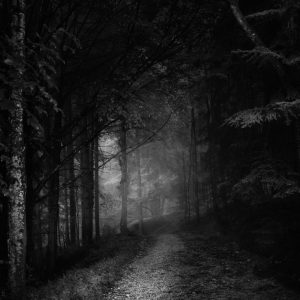
Outsiders called this place darkness, whispered of shuttered houses and women with shadows for companions. Naya had grown up with the resin smoke, closed rooms, the forest that surrounded this corridor leaning close. The outsiders had long ago driven her mothers and grandmothers into these forests.
Among the outsiders something tight, something with a spark of heat, had taken residence beneath her ribs. They thought her strange for her silences, for counting in threes. The men watched her too closely, curiosity heavy where it did not belong. She came back. She always knew she would.
She tapped one vial with her nail. Breath turned archive. Archive turned pattern, the body rendered legible.
Three ampoules waited, blue shadows lengthening in the light. Three ampoules: past, present, future, knots in the same thread. She did not count them aloud. Her foremothers had carried racks of such vials into the forest, measuring human exhalations against the millivolt pulses in spruce cambium. Both rhythms shifted and diverged prior to eclipse. Bodies and trees registered the same attenuation. They had once been called reliquaries, and women had filled them at births and deaths.
From the next room came the sound of Isaa’s breathing, uneven, pulling short then catching up. Naya let it occupy the silence. The sound tightened her throat; every staggered inhale pulled against a limit that would not give.
She remembered the first time Isaa had laughed in the kitchen—flour on her hands, reflexes intact.
Naya wrapped each ampoule in soft cloth so the glass wouldn’t knock together on the trail. The fabric was from Isaa’s old shirt, faded blue, thinned by years of washing. She tied each square neatly and pressed the knots flat with her thumb. Always three knots. Always pressed three times.
The faint clink of Elder Edda’s boot buckles sounded on the porch before the door opened. The shutters creaked when she pushed past them, the corridor’s cold air spilling in: wet stone, resin smoke, iron bite. The shutters swung back into place with a dull thud, sealing the house again. Without speaking, she set her coat on a chair and stepped into the bedroom. Naya watched her from the doorway as she touched Isaa’s ankle through the quilt. The rhythm of Isaa’s breath hitched.
Edda turned back. Her eyes found the ampoules on the table, the blue cloth bundles lined in a row. She gave a single nod. “We walk now,” she said. Her voice carried the clipped cadence of corridor women. “Elderlight won’t wait,” she said, using the old cadence—the word weighted toward inheritance more than time.
Naya looked at Isaa. Isaa’s eyelids trembled but stayed closed. Sweat glistened at her hairline. The illness hadn’t shown itself in blood work, never landed in a diagnosis. The doctors called it functional, idiopathic—meaning nothing they could touch and nothing they would own. What mattered was the way Isaa’s body fell out of step. Each day she faltered thinner, grew paler and more distant. Edda had not commented on the outside doctors she’d taken Isaa to, just as she had not commented when Naya left.
“Let me come,” Isaa murmured without opening her eyes. Her voice was thin, a crust of pale blood on her lips. “I can walk it. I can ask for myself.”
Edda shook her head. “You won’t make it that far, child.”
Naya crossed the room and crouched by the bed. The smell of nettle tea clung faintly to Isaa’s hair.
Naya stood. She tightened the strap of her pack across her chest. Inside it lay the ampoules, their sealed breath waiting, volatile compounds already beginning their chemical drift, recording Isaa’s body’s present state. She imagined how the trace would look in a chromatograph—peaks shifted, rhythms skewed. She calculated whether the pattern could be slowed before degradation exceeded tolerance. Isaa’s samples showed an anomaly Naya never logged: the pauses were disappearing faster than the peaks.
Edda fastened her coat. Looked at Naya for hesitation.
Naya glanced once more at Isaa, then followed Edda to the door. The house’s scent of resin, dried nettle, and the faint sweetness of red elder tea clung to her as she stepped into the chill air.
Outside, fireweed lined the ditch, stems bent under last night’s rain. Edda plucked one and tucked it into Naya’s pocket. Her hand lingered, then withdrew. The floss caught against the muted gray-purple of her homespun shift, alder bark and iron dye from summer. It clung a moment before she pressed it flat with her thumb.
Naya pulled her coat close, let her hands drop. She focused on the path ahead, where the road narrowed into shadow.
The maples gave way first, their leaves slick with dew, edges trembling without wind. Naya’s boots darkened where the wet brushed against them, and her calves caught the cold. She listened for Isaa in her own chest—the uneven rasp, the missed beat—but the forest pressed in with louder signs: jays stitching notes overhead, a squirrel scolding something unseen. The echoes lingered too long, as though the trees held sound a moment before letting it go. Then the echoes cut off sharp, like a blade through cloth. Even those sounds registered as provisional.
Spruce closed in, the loam soft underfoot. She counted her steps in threes, the habit steadying her. Resin thickened in her throat, metallic as pine needles. She shifted the pack to keep the ampoules close. Each step registered with unwanted precision. A root slick with moss caught her heel. She lurched, ankle biting hot, and clutched the strap of her pack against her chest, listening for the noise of glass against glass inside. Pain hummed low, rhythmic and persistent.
Ahead, Edda slowed. Her hand lingered against a trunk. She did not look back, but her shoulders rolled tight with the effort of keeping her pace even. The trees crowded close, bark furrowed and familiar, familiar enough that she almost reached for one. She stopped herself, teeth against her lip. If they had doubled back, Edda gave no sign.
She shook her head. Imagined the chromatograms she’d studied in school: sharp peaks rising for acetone at dawn, flattening by noon, isoprene pulses matching exertion, stress hormones leaving their chemical shadows. A system rendered visible. Her body traced its own skewed graph now—ankle throbbing, breath shallow, each step tugging the line further off course.
Edda stopped ahead, hand lifted. The birds had hushed, their absence abrupt. Elderlight beginning—the full dark of the eclipse, when the trees’ internal signals converged outside baseline tolerances. The hush compressed her ribs, imposing a load she had not calibrated for. She recalled Isaa’s voice, the way it altered a room’s acoustics. The effect had always been temporary.
Naya drew closer, breath destabilizing. The window would close with the first birdcall. She felt the silence not just in her ears but under her skin, a low pressure that pressed against bone. The first trunks fell into shadow: old spruce, bark plated with lichen, lightning scars running jagged and healed. The ground under them was springy with fungal threads.
Her breath quickened. She reached back to touch the pack, confirming the ampoules were still there. If they shattered, the gases inside would vanish in seconds—data dissipated beyond recovery.
The Rootwell lay in the deepest part of the forest, past the granite boulder that marked the threshold. She pressed her palm to its cold face as they passed. Past it, temporal markers degraded.
Edda’s voice was quiet. “The spring waits under the three roots. Speak only once. Make it clear.”
Naya’s throat was dry. She rehearsed the phrasing in her head and found the verbs blurring, collapsing toward the same inadequate word: need. She thought of the ampoule slipping, her words stumbling. She counted three breaths to steady herself; the third caught ragged. Isaa’s face rose in her mind: damp hair, fever-glazed dark eyes. A thought rose, unwanted and sharp: Let it take me instead.
She shut it down with the discipline she used on bad data.
She nodded to Edda and stepped toward the root-arch and the waiting pool.
The Rootwell opened where three spruce trunks braided their roots above a spring. The roots arched into a natural chamber, soil compacted by repeated access. The water below gleamed faintly, surface broken by resin drifting down in droplets. Cold breathed out of the gap, sharp enough to rattle Naya’s teeth. The chamber predated reliable language. Even the air flowed downslope toward the water.
She slid the pack off her shoulders and knelt. Her knees pressed into damp earth. She laid out the ampoules, unwrapping each from its square of Isaa’s shirt. Glass gleamed against the shadow.
Naya touched the first with her fingertips. It held her exhalation from that morning: mostly nitrogen and oxygen, but also her unique chemical record—acetone, isoprene, trace ethanol, aldehydes. Those compounds were already shifting, reacting—metabolic drift arrested only temporarily.
She bent close to the water. “Isaa’s body is failing,” she whispered. “I bring my breath and hers. I request stabilization. Enough to maintain function.”
She pulled the bark stopper free. Resin wax cracked. She tipped the ampoule, releasing her stored breath into the spring. Bubbles of fog swirled, burst, vanished. Her chest tightened. A sharp stitch spread through her side, deep enough she winced. The first cost. She named this breath silently as the past, the exhale already spent, irreversible.
Naya opened the second vial. The taste of spruce resin filled her mouth, though she hadn’t touched it. Pressure built against her ribs, steady, unrelenting. She held her breath until her chest burned, then exhaled fully into the glass and released it. Her head swam; for a moment the roots blurred, three braids twisting into nine. She blinked hard, counted three times to steady herself.
The needles stirred without wind. Naya’s skin tightened as Elderlight fell—moon crossing sun, illumination dropping into dark.
Her hand hovered on the third ampoule. This one she had filled differently: she had drawn in a strand of Isaa’s hair, comb-caught and still carrying her scent, then breathed over it into the glass. Isaa’s chemistry, altered, skewed by fever and disorder, and hers. The bark stopper came loose with a soft crack, resin tugging at her fingers. She steadied her hand against root, cold roughness pressing into her palm. This was the future, an unvalidated projection.
The water below barely rippled. Pressure gathered inside her ears, along her jaw, deep in the bone. Steady, thick and low. Her vision flared white at the edges. The silence thickened until she was certain she had stopped breathing entirely. She counted: one, two—on the third number her lungs dragged in air. It scraped her throat raw.
She tilted the ampoule. A strand of Isaa’s hair slipped free and clung to the surface before sinking. The trapped breath followed in a scatter of fog. Naya leaned forward until her forehead touched root, slid her hand under cold water. She offered her words into the space without decoration. “Integrate this pattern. Stabilize deviation…” Her tongue went numb mid-word, the syllable collapsed in her mouth, wrong, as if she were speaking with someone else’s breath. Cold lanced up Naya’s arm, into her chest, into her lungs. Her breath hitched. “One season. One cycle.” Her pulse faltered, skipping.
The silence became a weight pressing her spine into the soil. The surface tension of the spring broke on its own, as if the water had inhaled. Something in her ribs fractured, internal and sharp. A faint drop in air temperature, the hush thickening so the silence carried weight, the spring’s cold radiating harder against her hand. Vision intruded: Isaa upright among maples, gait corrected, respiration even. No promise or confirmation, only a glimpse of what might be.
Naya lifted her head, dizzy. Her hand came out of the water aching with cold. When she tried to draw breath, it rasped—thin, uneven.
A thrush tested a single note. She wrapped the empty ampoule in cloth, fingers clumsy. Each motion reminded her she still had weight. Naya rose to her feet. Slung the pack over her shoulder, the straps stiff with damp. Her knees resisted straightening, but she forced them to lock.
Edda waited at the arch, her hands tucked into her coat sleeves. She gave a single nod, the way records were closed. “It’s done.”
The corridor felt different now. The trunks stood heavy and alert as they retraced their path. Past the granite boulder, its face slick with condensation. Past the mycelium-threaded soil that sprang underfoot. The silence began to unravel as light returned. First a warbler, then the chatter of a squirrel, then the forest’s full sound returning as if nothing had happened.
Each breath scraped cold through Naya’s throat, uneven, deep winter frost lodged beneath her sternum. She counted her steps in threes, but the third always faltered. One. Two. Then a catch.
At the edge of the woods, fireweed fibers drifted on the air. The ditch shimmered with insects. Sunlight pressed hard against her eyes, almost too bright. Naya touched the pack again. Inside, the three spent ampoules carried the residue of what she’d done.
The house was quiet when they returned, shutters drawn against the noon glare. Naya eased the door shut behind her, careful not to let it strike the frame. Resin clung to her hands—sharp, acrid—and followed her into the dim rooms.
Isaa lay where they’d left her, quilt tangled at her knees. Naya knelt and set one of the empty ampoules on the nightstand. Glass caught the thin light.
Isaa’s eyes opened. She inhaled—clean, deep. Another breath followed, unbroken. Color had returned to her cheeks, faint but real. Her gaze tracked Naya’s face with focus that hadn’t been there in weeks.
“You’re cold,” Isaa said. Her voice was steady.
Behind them, Edda filled the kettle. Set it on the stove. No words. No questions.
Naya sat by the bed and took Isaa’s hand. Warm. Too warm, after the spring. She tried to slow her own breathing to match Isaa’s rhythm and failed. Her lungs burned shallow and tight, each inhale stopping short as if caught.
That night, after Isaa slept, Naya stepped outside. The forest loomed, intact and dark.
She exhaled.
The air in front of her moved in a soft, filamented plume, pale and slow, carrying the exact stagger of her breath. It hung on the air, drifted outward, drawn toward the trees.
Naya froze.
Branches stirred without wind. Needles lifted. From somewhere deep among the spruce, a sound emerged—not animal, not voice, but the measured rasp she knew intimately: one breath completing late, another starting too soon. Her cadence, reproduced cleanly, practiced.
The sound multiplied.
It moved through the understory in overlapping waves, the forest breathing in many places at once.
Naya backed into the doorframe, heart hammering, lungs refusing her. The breathing did not follow—but it did not stop.
Inside, Isaa turned in her sleep. Her chest rose and fell with smooth, efficient precision. Too precise. As if something else now carried the labor for her.
Naya shut the door.
She pressed her palm to her sternum as the sounds continued beyond the walls, her own breathing thinning, faltering, threading outward into the dark.