By Caitlin Taylor So
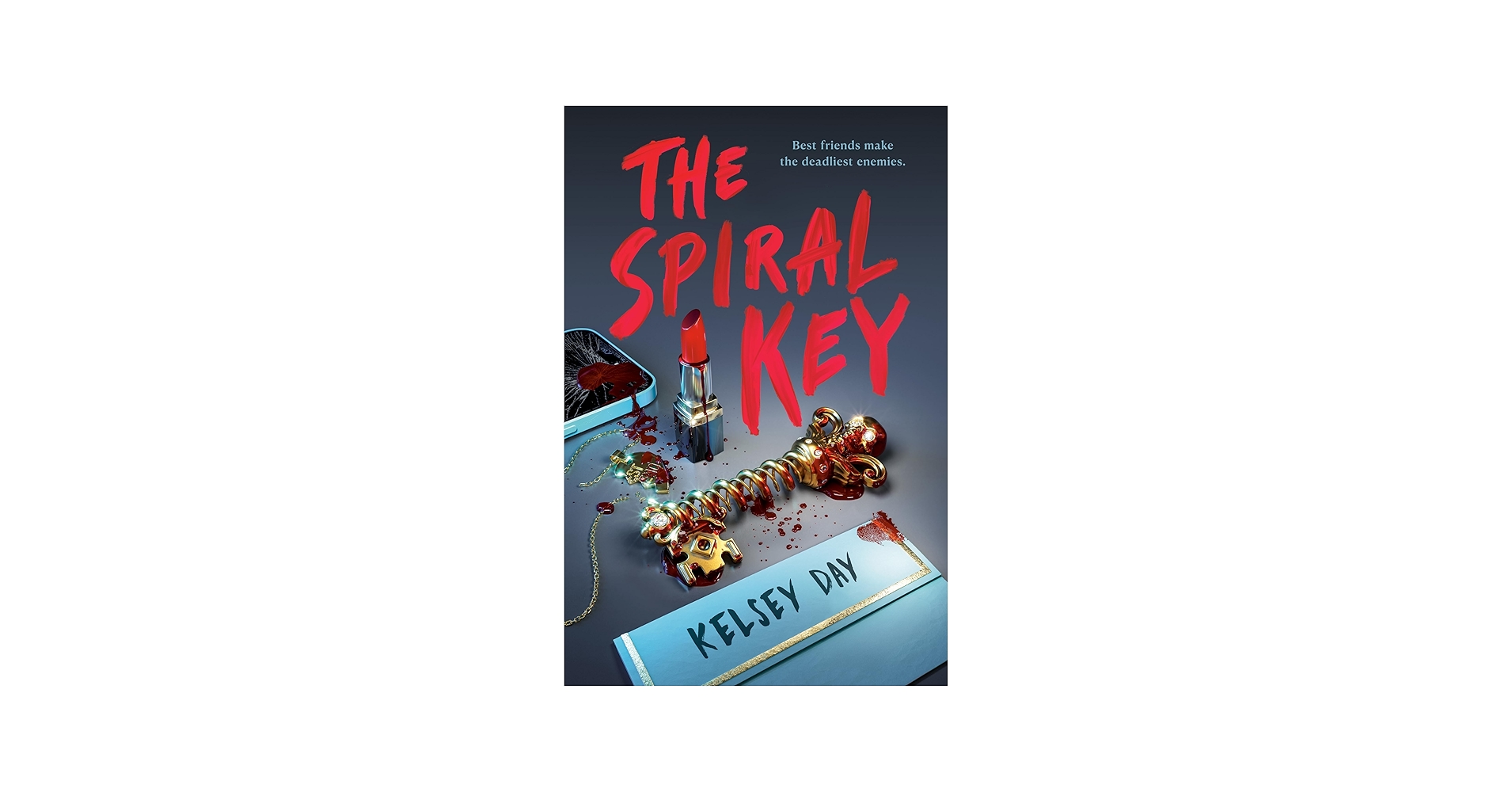
It was the greatest joy to ask author and poet Kelsey Day questions about their first novel for young readers, The Spiral Key, which has been out since February 24th of this year.
This was especially exciting as Kelsey was my former classmate at Emerson College where I had the privilege of witnessing their raw talent for creative writing.
The Spiral Key starts at Lincoln Academy where Madison Pembroke, the most popular girl in school, has the whole school waiting with bated breath for their custom-forged spiral key: otherwise known as an invitation to Pembroke’s epic and exclusive birthday party.
Each year, Pembroke hosts her party in Ametrine, a virtual paradise perfect for an unforgettable night. Bree Benson, Pembroke’s childhood ex-best friend, has never received an invite to Ametrine…until now.
Could a spiral key be an olive branch, capable of rekindling an equally formative and all-consuming friendship between the two? Or could it be a dagger, severing their divide even deeper until someone delivers the killing blow?
Get your copy of The Spiral Key today and read my interview with Kelsey Day below!
CAITLIN TAYLOR SO: There are so many fictional depictions of artificial intelligence and virtual reality across different books, shows, and movies and there will always be an interest for more as this technology continues to advance and disrupt our real world. Are there aspects of Ametrine, the virtual party paradise in The Spiral Key, that were shaped, informed, or inspired by other fictional virtual realities? How did you wish to build upon how people, especially teenagers, currently use and engage with VR and AI today?
KELSEY DAY: Virtual realities in YA fiction are often portrayed as training environments, where kids compete, learn, or fight in a controlled environment (The Roar, Ender’s Game, etc). These VR spaces represent a kind of “trial run” where the stakes are real but not real at the same time—which is often how adults treat teenagers, like their lives and experiences aren’t fully real yet because they’re not yet adults. I wanted to do something slightly different, where the stakes of ordinary teenage life are magnified and made deadly, so the virtual world reflected the real emotional world of the characters.
But this VR world is not individualized to each player, nor is it a glimpse into some universal teenage experience. Ametrine is not neutral. It is controlled, very notably and dangerously, by one particular student, whose parents are wealthy tech developers. In this way I wanted the story to point toward the ways in which virtual reality and AI are not, indeed, neutral technologies, but rather developed in a particular economic and social context—often by people who do not prioritize the wellbeing of young people.
CTS: The book also heavily focuses on the relationship between Madison Pembroke and Bree Benson, two ex-best friends and the tense, unspoken intensity between them, lasting long after their fallout.
Friendship breakups are uniquely painful compared to romantic ones, and then you add layers of it being a defining childhood female friendship with queer undertones and it becomes that much more devastating, emotionally. How did you approach channeling and balancing these characters’ shared grief and the ways they would express it to the world and to each other?
KD: Something I returned to over and over again while writing the book is the question of memory, and how humans often (subconsciously or otherwise) edit memories of conflict in order to survive them. The stories that we tell ourselves, and the stories we tell others, impact our experience of the past. Those differences in memory can result in a power struggle as each person clings to their version of the story. I wanted to write into that charged space of contradiction.
CTS: We’re introduced to a diverse and casually queer cast of characters in The Spiral Key. Their identities are revealed matter-of-factly and provide depth and context to them as people. What was it like crafting and getting to know them as you were also building this reality around them? What came first: Ametrine or the characters, or did you work on them simultaneously?
KD: As a writer, I often start with a speculative concept and then develop the characters outward from there. It was important to me that each character have a specific relationship with Ametrine, and for those relationships to clash and entangle. Madison uses Ametrine to seek control. Chet seeks emotional release through VR violence. Bree desperately wants to form a community. Understanding their relationship to Ametrine helped me to understand who they were as people, what they wanted and feared.
CTS: I loved reminiscing about Boston through your book with mentions of the Public Garden and Newbury Street as well as getting to refamiliarize myself with the entire layout of the Isabella Stewart Gardner Museum. In what capacity did The Spiral Key exist while you were in college? Did it live as ideas in your head or scenes in a journal? Did you visit Boston and the places you referred to in your book as you were writing this story? Besides going to school there, what about Boston made it a special place for you?
KD: I love Boston. The Spiral Key didn’t exist for me during the time that I lived there, but I always knew I would return to it for a story setting. Boston was the place where I first truly came out and started exploring my queerness, so it has a very special place in my heart. I’ll be heading back to Boston next week for my book tour!
CTS: There are a few jaw-dropping moments that happen throughout the course of your book either because of a reveal or the sheer chaos that ensues. Without giving too much away, can you share how these moments came to you and the process of setting them up, seeing them through, and then, grappling with the aftermath?
KD: The twists and reveals in The Spiral Key were only possible because I sat down and plotted everything out before I started drafting. Some writers are able to make up their stories as they go along, but I couldn’t do that with The Spiral Key.
In order for all the twists to make sense and latch together in a satisfying way, I needed to plan everything out from the beginning. So it was a lot of pacing around the apartment, a lot of talking it through with my partner, a lot of internal back and forth, treating it like a puzzle.
CTS: You published poetry books prior to The Spiral Key. How does planning and arranging a narrative in a poetry collection compare to doing so for a work of fiction? Do you think your experiences publishing and sharing the last four years and rootlines prepared you for your ongoing journey with The Spiral Key?
KD: My poetry projects taught me precision at the line level. They also helped me to think about narrative scenes as interlocking conversations—in the same way each poem should push a collection forward, every scene in a novel should advance the story. My publishing experiences with the last four years and rootlines were certainly helpful in getting my foot in the door, though frankly nothing could have fully prepared me for my experience with The Spiral Key. It’s such a different world, working with traditional publishers. You surrender so much control, and have the privilege of working with so many more people!
CTS: What can readers expect from you next after The Spiral Key?
KD: I have a speculative YA novel on submission with publishers right now! I have no idea what’s going to happen, but I’m excited to find out. 👾
***
Kelsey Day is a young adult author and queer Appalachian poet. Their writing has appeared in The Atlantic, Orion Magazine, Freeman’s, and more. This is their first novel for young readers. You can find them online at KelseyDays.com or on Instagram @KelseyDays.
Purchase The Spiral Key here.
Born and raised in Queens, Caitlin Taylor So is a Chinese-Vietnamese writer who is passionate about prioritizing and amplifying marginalized voices. She graduated from Emerson College with a degree in publishing and marketing. Her writing can be found on Business Insider, PopSugar, WebMD, Medscape, The New Absurdist, and Her Campus Media.